We’ve all done it in a flight simulator. We select the biggest, fastest, or most inappropriate aircraft we can find and try to land it on the most challenging runway in the world. For many, that challenge is the Tenzing-Hillary Airport in Lukla, Nepal.
Located at an elevation of 9,334 feet (2,845 meters), with a runway just 1,729 feet (527 meters) long that slopes dramatically downhill and ends in a sheer drop, Lukla is notorious for a reason. It is strictly for STOL (Short Take-Off and Landing) aircraft, like the Twin Otter or Dornier 228.
So, what happens when you defy physics and try to put a supersonic legend, the Concorde, down on that postage stamp of concrete?
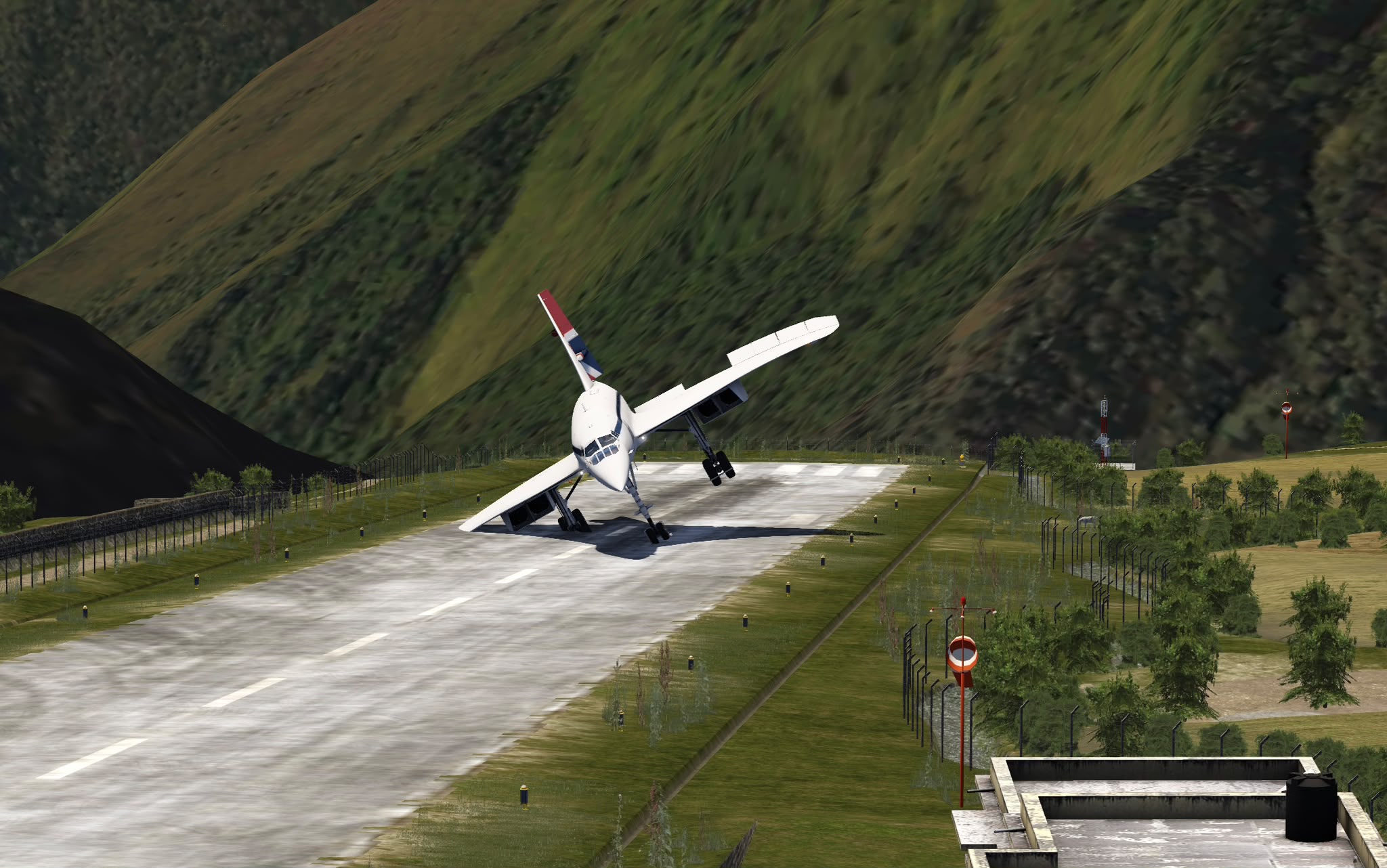
The image above tells the story better than words ever could.
The Supersonic Stall
The Aerospatiale/BAC Concorde is a masterpiece of engineering designed for Mach 2 cruise. It is not designed to operate at near-stall speeds, especially not at high altitude where the air is thin. To even approach Lukla’s runway, the Concorde must be flown at an impossibly low speed.
As seen in the photo, the aircraft is in a severe, nose-high attitude—the classic sign of an impending stall. The delta wing, which provides lift at high speed, is struggling to generate enough airflow. The pilot has hauled the nose up, attempting to arrest the descent, but the aircraft has already begun to drop like a stone.
Off-Center and Overweight
Even if the speed were manageable, the physics don’t add up. The Concorde’s massive weight and high inertia make precision placement on the short, sloped runway nearly impossible.
In this attempt, the aircraft has missed the runway’s centerline entirely. It is banking sharply to the left, and its left main landing gear is already off the runway surface, chewing up the adjacent grass and dirt. This is not a landing; it is an uncontrolled arrival.
The red-and-white tail fin, a symbol of British Airways, is visibly tilted, emphasizing the catastrophic loss of control. The aircraft is seconds away from a catastrophic overrun and collision with the terrain. https://sahaniaviation.com